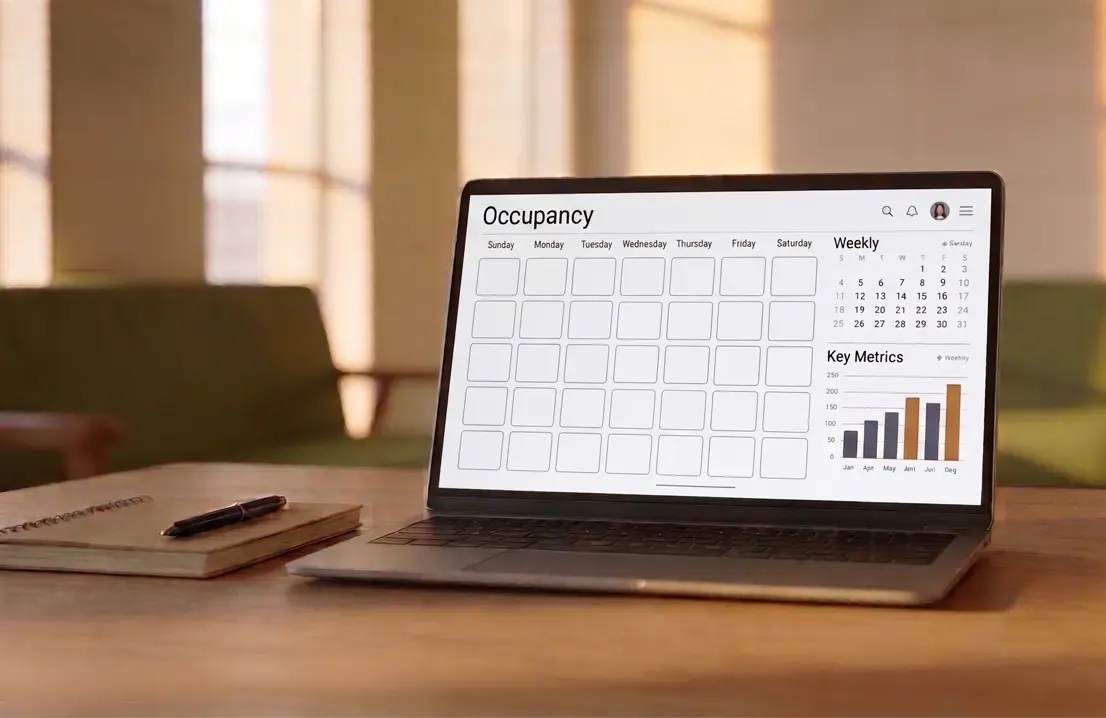
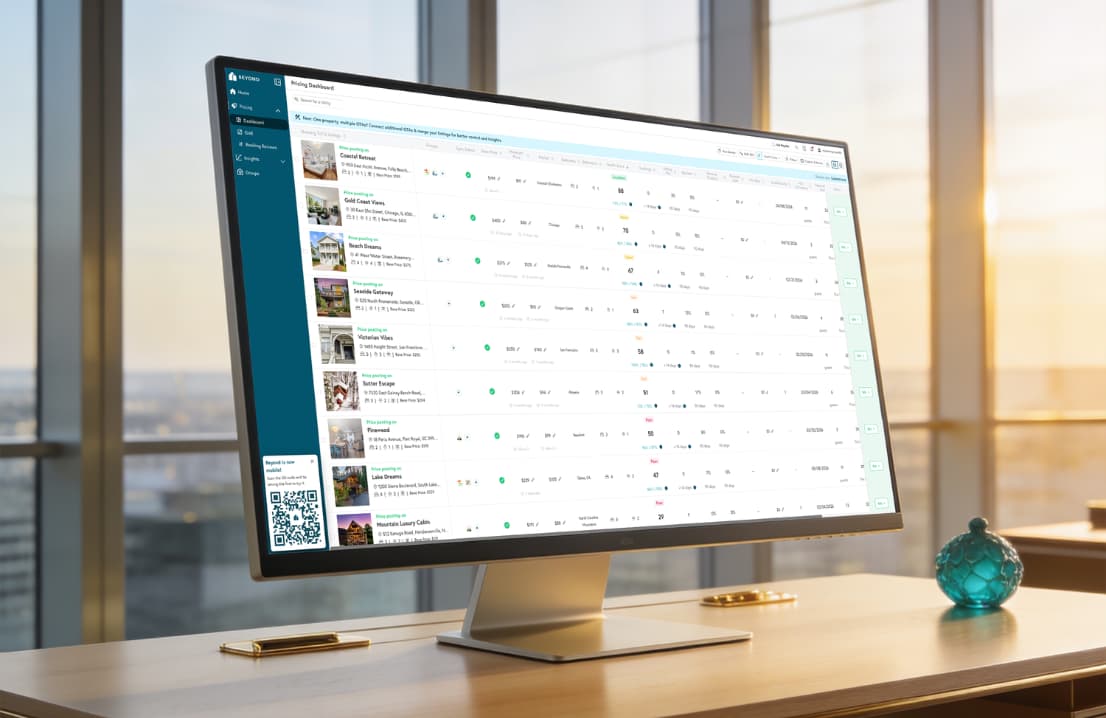
A few years ago, adjusting your prices once a week was enough to stay competitive. It was a straightforward process that did not demand much. Today, the market shifts by the hour, reacting fast is barely enough, and winging it is expensive.
The market does not forgive mistakes. Successfully managing a portfolio of short-term rentals in 2026 means staying several steps ahead. That is where vacation rental revenue management software comes in. It helps you automate repetitive tasks and build a competitive pricing strategy that sets you apart from other property managers. Choose the right software and your owners will trust you so completely that the only time they call is to renew their contract.
Key Takeaways
- Revenue management software automates price adjustments and reduces manual work for your team.
- The most complete platforms combine dynamic pricing, demand data, occupancy forecasting, reporting, and portfolio-level controls.
- Integrations with your property management system (PMS) and channel manager are non-negotiable to avoid rate discrepancies across platforms.
- Data quality is what separates a useful recommendation from a rate that just "feels about right."
- Choosing the right software directly impacts ADR, occupancy, RevPAR, and your relationships with property owners.
What Is Vacation Rental Revenue Management Software?
Vacation rental revenue management software does more than change prices automatically. Its real job is to help you react before the market does. It analyzes demand, booking pace, events, seasonality, and competitor behavior to adjust rates, restrictions, and your commercial strategy without your team having to manually review every calendar.
A PMS helps you manage reservations, guest communication, calendars, and day-to-day operations. A revenue management system has a different goal: maximizing the performance of every individual listing and your entire portfolio.
That distinction matters more than it might seem. Automatically adjusting prices is useful, but it does not mean you are doing revenue management. True revenue management combines demand forecasting, market analysis, restrictions, alerts, and performance reporting to help you make decisions with context, not just react to the competition. Because when you are managing 80 properties across markets as different as Miami, Nashville, and the Smoky Mountains, reviewing prices one by one stops being an operational task and becomes a bottleneck. And that is when the uncomfortable questions from owners start.
What Features Should Good Vacation Rental Revenue Management Software Have?
It all starts with the dynamic pricing engine. A good system should adjust rates based on demand, seasonality, events, competition, booking lead time, and occupancy pace. A strong tool does more than drop prices when there are gaps in the calendar. It also detects when the market is accelerating and raises rates before the competition does. If you want to explore how these tools work independently, this article on dynamic pricing tools explains in detail what capabilities set them apart.
The second key element is market data. Without real demand information, booking pace, and local benchmarks, pricing management ends up being a slightly more sophisticated version of "I think this price might work." And when you are managing a large portfolio, making decisions by gut feel stops working fast.
Then come integrations. The system needs to connect with your PMS, channel manager, and distribution platforms to update prices and restrictions automatically. Because if your team is still copying rates across platforms, you do not have automation. You have more room for error.
And here is one of the most underrated features: owner reporting. Owners do not want to hear that "the algorithm decided to lower prices." They want to understand how their property is performing and why a specific decision can generate more revenue.
Finally, you need portfolio-level controls. You cannot manage a downtown apartment in Austin the same way you manage a beachfront house in the Outer Banks. The system needs to let you segment strategies, automate rules, and review exceptions without forcing you to go property by property.
The Types of Revenue Management Software Available on the Market
Not all revenue management software works the same way.
The first category is full revenue management systems. These combine price adjustment, market data, automation, reporting, and strategic controls. They are the right fit when you are managing a growing portfolio and need consistency across properties, markets, and owners.
The second category is pricing-focused tools. They tend to be effective at adjusting rates but can fall short if you need owner reporting, advanced forecasting, or visibility into market demand.
The third category is pricing modules built into a PMS. They have one clear advantage: they are part of your daily operational workflow and allow you to automate rates quickly. The question is whether that module can support a revenue strategy at scale or whether it only solves today's price.
The fourth category is market data and trends platforms. They help you understand demand, competition, and market behavior, but they do not always execute price changes automatically. In many cases they need to be combined with another system to turn that data into action.
The right choice depends on your operational maturity. If you are still putting out fires day to day, a simple solution might seem like enough. But when you start managing owners, a team, multiple markets, and profitability targets, you need a system that keeps working when your portfolio grows from 10 properties to 100.
How to Compare Vacation Rental Revenue Management Software
Start by comparing data quality. Does the system analyze future demand? Does it detect events? Does it update recommendations frequently enough? A system that uses real-time market data can react before the market shifts.
Next, look at transparency. Receiving an automatic rate is not the same as understanding why the system recommends that price. That matters especially when you need to justify decisions to property owners.
The next point is integrations. Ask whether the sync is bidirectional, how often rates are updated, whether you can manage minimum stay restrictions, and whether the system works correctly with your current PMS.
You also need to evaluate scalability. The difference between managing 15 properties and 150 is not just a matter of volume. Every manual change adds operational complexity. You need to group properties, apply strategies by market, and receive alerts only when something needs attention.
Finally, review the pricing model. Some systems charge a percentage of booking revenue and others use a flat monthly fee. But more important than the cost is the impact: how much additional revenue it generates, how much time it frees up for your team, and how many errors it prevents.
The Role of Revenue Management Software in Owner Relationships
When a property owner does not understand the logic behind the rates published on their listing, the uncomfortable questions start.
A good revenue management system reduces that friction. It lets you show that a rate drop responds to lower demand, or that a rate increase is tied to an event or a surge in market bookings.
That changes the conversation with the owner. You move from "trust me" to "here is the data." For a professional property manager, that difference is critical for retaining accounts and winning new properties.
When sharing data with your owners, they are not expecting you to talk about average daily rate, booking pace, or market behavior. Jennifer simply wants to understand why her property is making more or less money than last year. That is where good reporting makes the difference.
Because when an owner asks why they should hand you their property, being able to show clear data and professional reports communicates something very specific: nothing here is left to chance.
.jpg)
What to Look for When Choosing Your Platform: A Checklist for Property Managers
Before choosing a platform, review these points:
- Does it have reliable data and sufficient coverage in the markets you manage?
- Does it integrate with your current PMS and channel manager, and is the sync bidirectional?
- Does it update prices and restrictions frequently enough to react to demand changes?
- Does it allow controls by portfolio, market, owner, or property type?
- Does it explain why it recommends a specific rate, backed by market data?
- Does it include automatic owner reports that can be downloaded directly from the platform?
- Does it offer onboarding support for teams?
Conclusion: Choosing the Right Revenue Management Software for Your Portfolio
Vacation rental revenue management software should not be a tactical purchase. It is a decision that affects how your portfolio grows, how you work with owners, and how much time your team wastes on manual tasks.
When you choose well, you stop reviewing prices property by property. Your team can react before the market shifts and conversations with owners stop relying on gut feeling and start leaning on real data. The challenge is staying in control as the portfolio grows and operations get more complex.
This week, review how much time your team spends changing prices manually, how many decisions you can back up with market data, and how many owner questions are still hard to answer. That is usually where the difference lies between having a pricing tool and having a real revenue management strategy.
If you are also thinking about the operational side, The Automation Playbook covers how to reduce manual work without losing control of your portfolio.
Frequently Asked Questions
What Is the Difference Between a Property Management Software and a Revenue Management Software?
A property management system (PMS) handles the operational side of the business. It automates and coordinates tasks like managing reservations, guest communication, and housekeeping. A revenue management system, on the other hand, helps you improve the revenue your properties generate.
How Much Does Vacation Rental Revenue Management Software Cost?
It depends on the provider, the number of properties, and the pricing model. Some charge a percentage of booking revenue, typically between 0.5% and 2%. Others use a flat monthly fee. More important than the cost is the impact on revenue, time saved, and decision quality.
Can Revenue Management Software Integrate With My PMS?
Yes. Leading platforms integrate with the major property management systems including Lodgify, Hostfully, Guesty, Avantio, and others. Before choosing, confirm the sync frequency, whether the integration is bidirectional, how it handles minimum stay restrictions, and whether it is compatible with your current distribution platforms.
What Data Does Revenue Management Software Use to Calculate Prices?
It analyzes multiple market signals to adjust rates: local demand, events, seasonality, booking pace, comparable listing prices, booking lead time, and the historical performance of each property. More advanced platforms also detect real-time demand shifts. The difference between a basic tool and a more complete one usually comes down to the quality, coverage, and freshness of that data.
Do I Need Revenue Management Software If I Already Use Airbnb Smart Pricing?
For an individual host, it may be enough. For a multi-channel property manager, it falls short. Airbnb Smart Pricing optimizes for that platform and tends to prioritize occupancy over revenue. External vacation rental revenue management software uses broader market data, gives you control across all channels, and provides the reporting you need to defend your strategy to property owners.