

The best vacation rental pricing strategy combines a well-calibrated base rate with dynamic pricing that responds in real time to demand, seasonality, local events, and booking window trends.
For property managers running dozens or hundreds of listings, the challenge isn't setting the right rate for one property; it's keeping an entire portfolio aligned with the market, protecting average daily rate (ADR), and defending those decisions to property owners.
Key takeaways:
- The best strategy combines a solid base rate with dynamic pricing that adjusts to demand, seasonality, and events.
- Portfolio managers need consistent rules and market data to defend pricing decisions to owners.
- Dynamic pricing can increase revenue by up to 40% over static strategies in competitive markets.
- Automating pricing reduces manual errors and frees up operational time across multi-property portfolios.
- Communicating your pricing strategy to property owners is just as important as the strategy itself.
Why Your Pricing Strategy Determines Portfolio Profitability
Many managers still adjust prices with one goal in mind: fill the calendar. The problem is that in professional portfolios, chasing occupancy without protecting ADR typically compresses margins and raises uncomfortable questions from property owners.
Rates don't just affect a single booking, they also directly impact portfolio profitability, RevPAR, occupancy, and the confidence your owners have in your business. When pricing changes only happen after reservations start coming in, you're already behind. The only lever left is last-minute discounts, and that's where margins disappear, and owners start comparing their property's performance to the one down the street.
A strong pricing strategy isn't just another operational task. It's the system that protects revenue and keeps owner’s trust intact.
How to Set the Base Rate for Your Vacation Rental Listings
Your base rate is the starting point for everything that follows. Get it wrong, and dynamic adjustments can only do so much.
Building a strong base rate requires reviewing four elements by property type, not across your whole portfolio at once:
1. Real Operating Costs
Cleaning, laundry, maintenance, OTA commissions, staffing, and software costs. Not to set your final rate, but to understand your minimum profitable nightly rate.
2. Target Margin
An urban apartment with high year-round occupancy may prioritize stability and volume. A highly seasonal property needs to protect ADR during peak months. The key is calibrating the strategy to the demand behavior of each property type, not applying the same logic across all listings.
3. Competitive Set Positioning
One of the most common mistakes is benchmarking against listings that don't actually compete with yours. Your comp set shouldn't be built on location alone. Factor in capacity, visual quality, guest reviews, included amenities, minimum stay requirements, and guest type. Two properties in the same neighborhood can require entirely different strategies if one books families three months out and the other depends on last-minute weeknight stays.
4. Portfolio Segmentation
Properties that book far in advance, apartments that perform better mid-week, and listings that rely on low-season last-minute demand all have different demand patterns. Applying the same base rate logic to all of them creates inconsistencies that automation alone can't fix.
Dynamic Pricing: The Best Vacation Rental Pricing Strategy at Scale
If you manage a portfolio of properties, dynamic pricing is no longer optional. The market moves faster than any team can track manually, and those who adjust late usually lose margin even when they eventually fill the calendar.
Dynamic pricing automatically adjusts rates based on forward-looking market occupancy, booking pace, booking window, local events, seasonality, and competitor availability. The goal isn't to change prices constantly; it's to adjust them while there's still margin to capture that a fixed rate would have left behind.
During events like SXSW in Austin, Art Basel in Miami, or Fourth of July weekends in coastal markets, demand accelerates months before most managers see it in their calendar. A dynamic system detects that early and adjusts at the moment demand starts moving, not once it's already obvious.
As your portfolio grows, manually reviewing rates starts generating inconsistencies, delayed adjustments, and an unsustainable operational burden. That's why many managers are moving toward full revenue management platforms, not just tools for changing rates.
Understanding how a dynamic pricing algorithm works helps you configure rules, floors, ceilings, and performance goals more effectively. Tools like Beyond analyze millions of market signals to adjust rates in real time, well before those shifts become visible on any calendar.
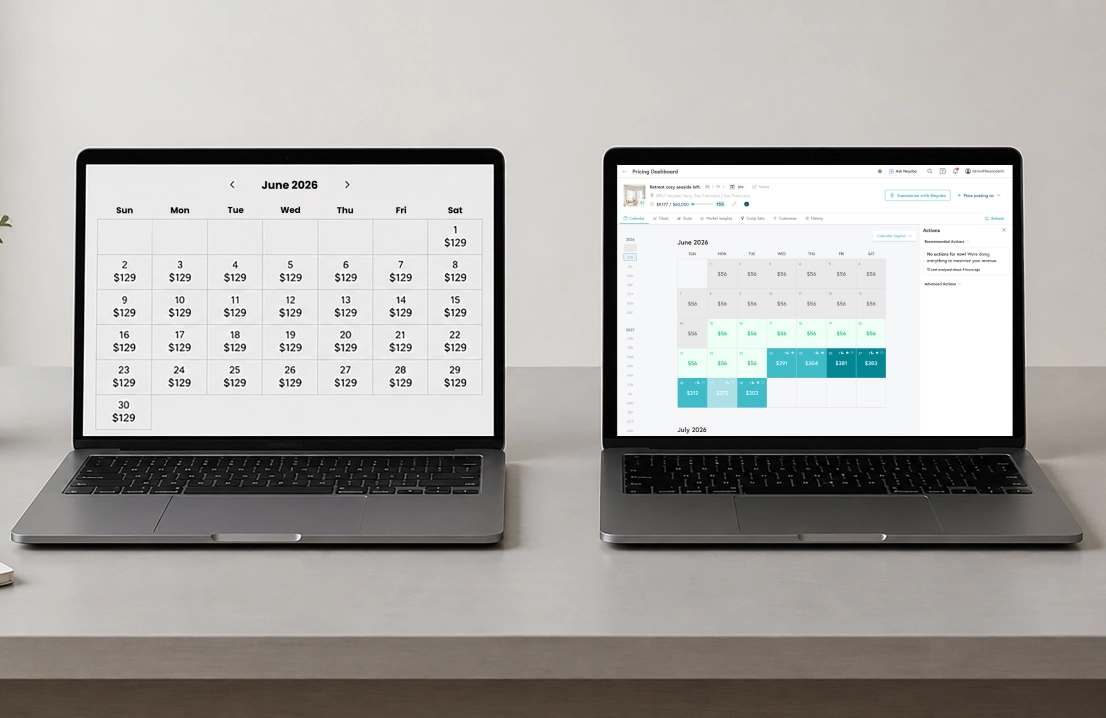
Static vs. Dynamic Pricing: Which Is Right for Your Business?
Static pricing doesn't fail because it's wrong. It fails because the market changes faster than any team can keep pace with manually:
Seasonality and Rate Adjustments by Time of Year
Framing your calendar as just 'peak season' and 'off season' misses the reality of most markets. Within a single city, you'll find conferences, holiday weekends, music festivals, spring break, and weather-driven shifts, each with its own demand curve. A strong seasonal pricing strategy isn't about blanket rate increases. It's about identifying when demand actually starts, how long it holds, and which guest segments are willing to pay premium rates.
This plays out clearly in US markets. Short-term rental demand around events like Coachella in Palm Springs, Jazz Fest in New Orleans, or Lollapalooza in Chicago shifts weeks or months prior tothe dates. Beach markets in Florida and the Carolinas have very different dynamics from mountain resort markets in Colorado or Utah. Urban markets like Nashville or Scottsdale can spike around bachelorette events that never even make a local news calendar. The calendars fill up, but the difference between adjusting at the right moment and adjusting late is the revenue left on the table.
Pricing Strategies for the Off-Season and Low-Demand Nights
The off-season is where sound strategies separate themselves from reactive ones. Filling empty nights by dropping prices isn't hard. The problem comes when those discounts erode profitability across entire months, or create questions from owners who see ADR trending down.
Tools built for low-demand detection let you identify those windows before booking pace deteriorates too much, without having to move your entire rate calendar.
The most effective approaches aren't the most aggressive. Adjusting only the dates where demand is softening, reducing minimum stays to fill specific gaps, or differentiating weekday versus weekend pricing typically outperforms broad rate cuts. Temporarily lowering rates isn't losing money; however, it's often the move that prevents much steeper discounts a few weeks later.

How to Communicate Your Pricing Strategy to Property Owners
One of the most demanding parts of any property manager's job is getting owners to understand why certain pricing decisions make sense. Because owners rarely look at the full market picture. What they typically see is a rate lower than last year, weeks still sitting open, or a neighbor claiming they're charging more for a comparable unit. Without context, any of those situations can turn into a difficult conversation.
Managing owner revenue expectations requires more than strong numbers. The managers who build the most trust aren't the ones who just share total income; they're the ones who use comparative data to contextualize results: ADR trends to show how rates are moving relative to the market, comparative occupancy to explain slower weeks, and RevPAR benchmarks to measure how the portfolio is performing against similar properties.
Having the right pricing strategy matters. But so does being able to walk owners through the logic behind every decision, before doubt turns into a difficult conversation.
Tools to Automate Your Vacation Rental Pricing Strategy
As your property count grows, the challenge isn't finding the right pricing strategy, it's executing it consistently across every listing without multiplying your team's workload. A modern dynamic pricing platform continuously updates rates based on real market signals: forward demand, booking pace, historical behavior, local events, competitor availability, and supply shifts. From those inputs, it generates automated adjustments, alerts, and reports your team can use both operationally and in owner conversations.
Tools like Beyond combine real-time supply and demand data with automation, market comparisons, and PMS and channel managers. The result is a more consistent pricing strategy, significantly less manual work for your team, and decisions that are far easier to defend to property owners.
Conclusion: The Best Vacation Rental Pricing Strategy for Your Portfolio
The best vacation rental pricing strategy isn't a single formula. It's a system that combines a well-calibrated base rate, dynamic automation, portfolio segmentation, and clear communication with property owners. The more properties you manage, the more important it becomes to have that system running consistently, rather than depending on manual reviews and reactive adjustments.
FAQs: Vacation Rental Pricing Strategy
What is the best pricing strategy for a vacation rental?
The most effective strategy combines a base rate calibrated to your operating costs and competitive positioning with dynamic pricing that adjusts automatically in response to demand, seasonality, and events. It's the only approach that consistently maximizes revenue at scale without relying on constant manual intervention.
How do I set a price for my vacation rental?
Three steps: first, calculate your minimum profitable nightly rate based on real operating costs. Second, analyze a representative comp set based on capacity, quality, and guest type — not just location. Third, apply dynamic adjustments based on demand, market occupancy, and forward booking pace.
What is dynamic pricing in vacation rentals?
Dynamic pricing refers to systems that automatically adjust rates based on market demand, local events, competitor behavior, seasonality, and booking windows. The goal isn't to change prices constantly, it's to find the optimal rate at any given moment for each property.
How do I adjust rates in the off-season without losing profitability?
The key is protecting annual revenue, not just point-in-time ADR. Calibrated last-minute discounts, flexible minimum stays, and booking-pace-based adjustments consistently outperform broad rate cuts applied too early.
What data do I need to build an effective pricing strategy?
You need to combine internal performance data (ADR, occupancy, RevPAR) with external signals: comp set behavior, forward market demand, booking window trends, local events, and industry benchmarks. Without that external context, pricing decisions are made with incomplete information.
.webp)
