Twenty properties on fixed rates are twenty bets that the market won't move this week, and that bet rarely pays off.
If you're finding out about a sold-out concert from social media, you're probably already too late to adjust your rates. Dynamic pricing in short-term rentals is the difference between getting ahead of demand and settling for whatever is left.
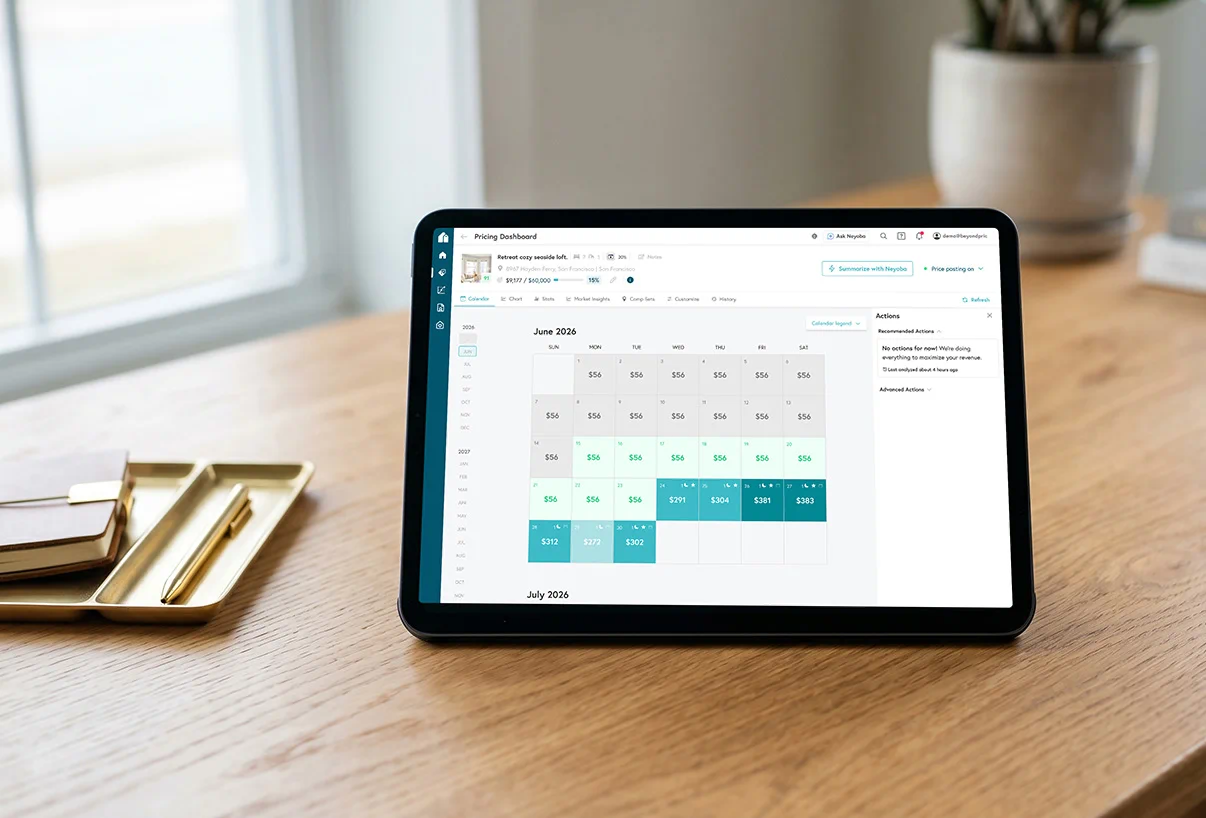
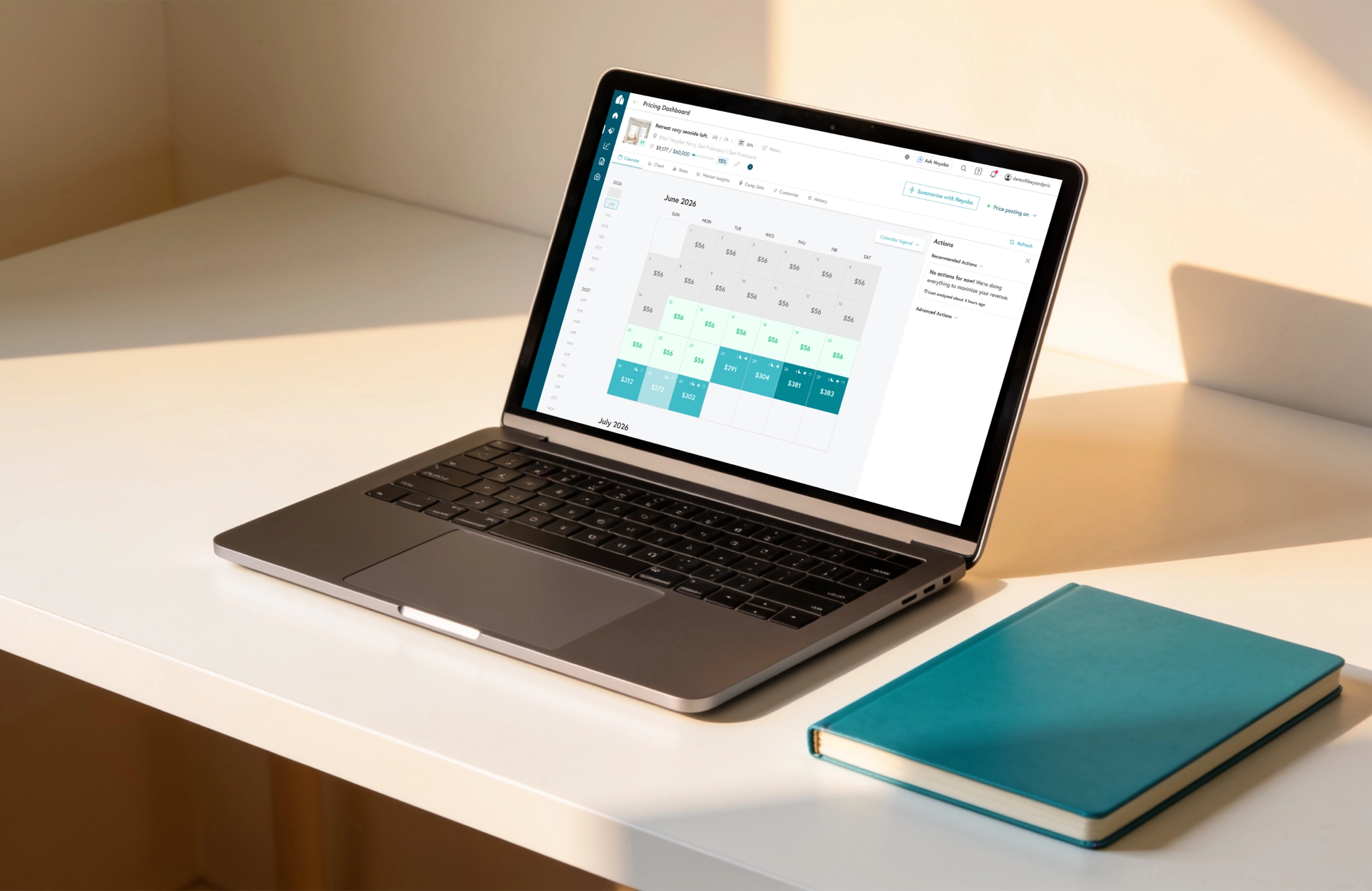
In short-term rentals, demand shifts by day, neighborhood, season, event, booking pace, market occupancy, and traveler behavior. If you're managing multiple properties, you need a system that adjusts prices at that same speed. That's what dynamic pricing delivers: moving from manual rate changes to automated adjustments driven by clear rules, reliable data and full control over your portfolio.
What is dynamic pricing and how does it work?
Reading the market in real time and adjusting your rate before your competition does. That, at its core, is what dynamic pricing in short-term rentals does. Demand, supply, seasonality, events, booking lead time, and competitive set occupancy: the algorithm processes all of it and moves rates within the limits you define.
The difference with fixed pricing is that a static rate only works when the market stays flat, and the market never stays flat. A Tuesday in February in a slow beach market, a holiday weekend in a mountain town, and a major festival weekend in a busy urban market should not follow the same pricing logic, even if the apartment is identical and the sheets are just as clean.
When you're managing multiple listings, the challenge isn't reviewing each property every morning. It's keeping pace with the market without manually updating every calendar. You define base prices, minimums, rules, segments, and objectives, and the system adjusts within those parameters as the market evolves.
Dynamic pricing vs. static pricing: why property managers are making the switch
Static pricing can hold up for a while, especially if you manage a small number of properties, know your market well, and have the bandwidth to review rates regularly. The problem shows up when demand starts moving faster than your ability to react.
And it doesn't announce itself loudly. It creeps in quietly. Sometimes, through a night that didn't get updated, a gap between reservations no one adjusted, or a local event the team spotted too late. Until it shows up in the monthly report, and an owner wants to know why their property underperformed.
A rate that looked reasonable three weeks ago can fall short today, especially when a holiday weekend, a local event, or an unexpected demand spike enters the picture. The same apartment in Nashville is not worth the same on a slow Tuesday in January as it is on a weekend when there's a sold-out stadium show, and every hotel in the city is full. Same unit, completely different market. Industry data backs this up: multiple benchmarks point to double-digit revenue improvements when managers move from flat rates to dynamic models.
Dynamic pricing also gives you a stronger answer when an owner asks for an explanation of a rate. If they question why a Saturday wasn't priced where they expected, you can point to demand data, competitive set behavior, and booking pace. You're not defending a gut call; you're explaining a revenue decision.
The benefits of dynamic pricing for property managers
The most obvious benefit is capturing more revenue when demand rises. But stop there, and you'll miss what dynamic pricing actually delivers.
The first benefit is a better balance between ADR, occupancy, and RevPAR. The manager who wins isn't always the one charging the most per night. It's the one who knows when to push rates up, when to prioritize occupancy, and when to turn an empty night into a booking.
The second benefit is time back. Dynamic pricing doesn't eliminate your judgment, but it does cut out the heavy lifting of manually reviewing weekends, spotting gaps between reservations, adjusting for events, correcting seasonal rates, benchmarking competitors, and updating calendars. When you're doing all of that by hand across dozens of properties, you're not managing a portfolio; you're managing a stack of sticky notes.
The third benefit is fewer difficult owner conversations. When rates move with a clear logic, explaining them takes less time and generates less friction. It also helps with owner retention, because you're presenting a pricing strategy they can understand, review, and trust.
The fourth benefit is scalability. When you're managing 5 to 10 properties, manual reviews are still survivable. But if every new listing feels like one more calendar to watch and one more fire to anticipate, growth starts to feel like a liability before you've even signed the next contract. Real scale requires process, automation, and solid reporting.
Dynamic pricing at scale: managing multiple listings
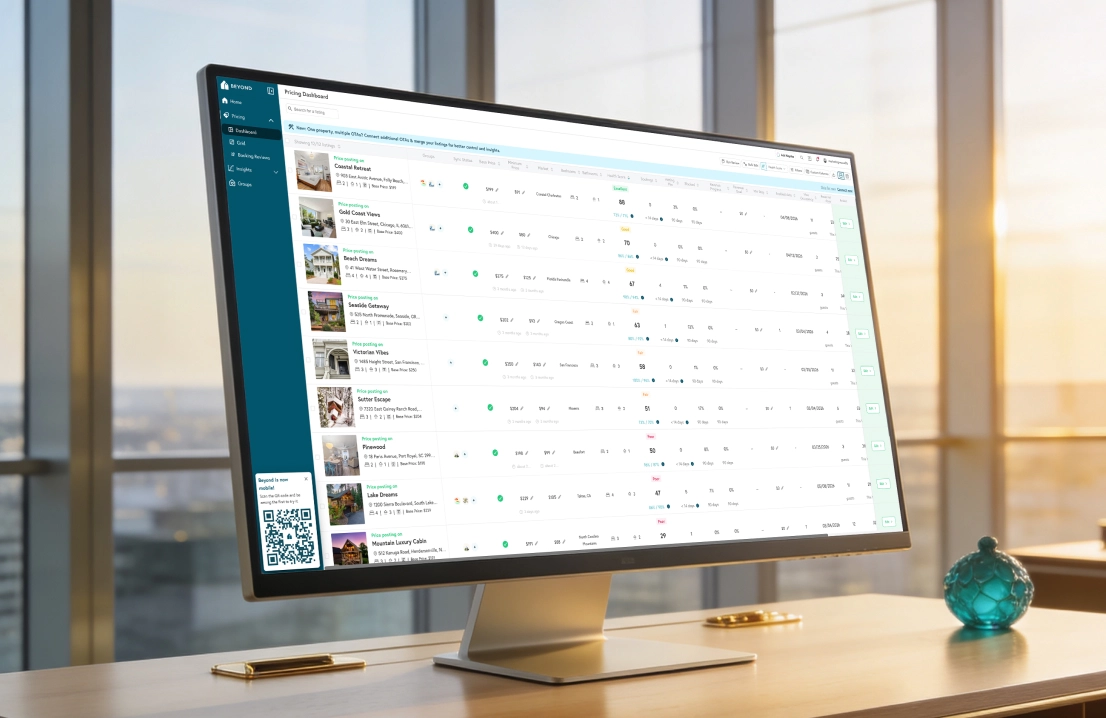
With one listing, adjusting rates means looking at a calendar. With 60, it means looking at a cockpit. If every night, every gap and every event depends on a manual review, you're not scaling a business; you're donating hours to daily operations. That's where dynamic pricing becomes non-negotiable. The algorithm can process those signals in seconds, but it doesn't act on its own. It works within your rules: base prices, minimums, objectives, seasons, and segments.
A city-center apartment, a lakefront cabin, and a large family home in wine country are not playing the same game. Good portfolio management means stepping back from reviewing 80 individual calendars and starting to manage logical groups. You can separate premium properties, listings that benefit from longer minimum stays, or urban apartments that respond to conferences, festivals, and sporting events.
The goal is to touch fewer individual rates and supervise more: catching anomalies, adjusting for high-impact events, and letting automation handle the repetitive work.
How to choose a dynamic pricing tool for your business
Finding a tool that automatically raises prices is not the answer. When you're managing multiple properties, you need one that understands your portfolio, connects cleanly with your existing operation, and generates reports that back up every decision, so that each rate change doesn't turn into an endless chain of "why is the price this?"
The first requirement is two-way integration with your property management system (PMS) or channel manager. Dynamic pricing only works when rates, rules, and availability move in both directions without getting stuck in transit.
You also need a tool that operates with transparency. An algorithm doesn't explain itself. You need to understand why the system is recommending a rate, because if you can't make sense of it, you won't be able to explain it to your owners. You set every guardrail: base prices, minimums, seasons, objectives, and segments, and dynamic pricing moves within that space.
Finally, watch for red flags: guarantees of X% revenue increases with no context, missing configurable minimum prices that can cause you to lose control of your floor, and no dedicated support. If the revenue management software doesn't let you control your margin, understand the recommendations, and get answers quickly, it was not built for a professional property manager.

Why dynamic pricing is no longer optional for professional managers
Dynamic pricing is becoming a baseline requirement in a market this competitive. Managers who haven't adopted it are competing at a disadvantage against those already running software that can adjust rates, track where demand is heading, and protect RevPAR faster than any manual process can.
The market won't wait for you to have a quiet morning to review your pricing. The sooner you build dynamic pricing into your strategy, the sooner you'll see the ROI where it matters most: fewer hours on manual reviews, clearer answers for owners and a portfolio that grows without every new listing becoming another operational risk.
Download Beyond's dynamic pricing guide and turn pricing into a system that helps you scale your portfolio without adding more manual work.
Frequently asked questions about dynamic pricing in short-term rentals
Is dynamic pricing right for managers with only a few listings?
Yes, especially if your properties are very different from one another. Managing rates for an urban apartment, a rural retreat, and a beachfront property is not the same exercise. Dynamic pricing helps you set minimums, rules, and demand logic from the start, so you can grow without every new listing disrupting your operation.
How does dynamic pricing affect owner relationships?
When explained well, it improves them. Owners don't just want to see rates change. They want to understand why. Dynamic pricing gives you the data to justify every adjustment with market signals, demand context, and clear parameters, instead of defending decisions on instinct.
Can dynamic pricing push my rates below what I want to charge?
Not if your minimum prices are configured correctly. Dynamic pricing shouldn't move freely: it works within the limits you set. Automation adjusts, but control stays with you.
What's the difference between Airbnb Smart Pricing and a professional dynamic pricing tool?
Airbnb Smart Pricing looks at Airbnb. A professional tool should look at your full strategy. Smart Pricing adjusts rates based on demand within the Airbnb platform and can be a starting point, but a professional property manager needs more: multi-channel visibility, PMS or channel manager integration, portfolio-level rules, configurable minimums, owner reporting and greater control over strategy.
How long does it take to see results with dynamic pricing?
It depends on your market, the season, and your typical booking lead time. You can see early signals fairly quickly, but the right metrics to track are RevPAR, ADR, occupancy, and booking pace. If you're expecting overnight results, fair warning: this is about solid setup, learning, and consistent monitoring.