Uno sguardo oltre

The Next Phase of Revenue Management

Across global markets, the short-term rental industry is moving into an era where revenue outcomes are shaped less by supply and price, and more by data interpretation, speed, and strategic alignment. Beyond’s analysis of +750 million of listings shows that this next wave of growth is coming from operators who combine future-facing data with operational execution, translating information into income faster than anyone else.

The Macro Themes Shaping 2026

  1. Demand Will Be Discovered in Search, Not Bookings

    Guest search intent data has become the earliest and most accurate indicator of demand. The gap between search peaks and booking peaks now averages less than three weeks, a window where proactive operators can win or lose the year.The STR businesses that infuse their marketing, pricing, and inventory decisions with search data will own the future.

    Takeaway
    : Integrate search data into your revenue management strategy, from forecasting and pricing to merchandising and distribution. Guests are already planning their 2026 stays, and having search data lets you anticipate demand shifts early, optimize your pricing strategy, and capture bookings before your competitors even realize the trend.
  1. Shorter Booking Windows, Same Lengths of Stay

    Lead times will keep compressing as consumer confidence in last-minute travel strengthens. The data shows guests are booking closer to check-in but staying the same number of nights, proof that spontaneity is replacing planning, not duration.

    Takeaway:
    For revenue managers, this changes everything. Forecasting cycles must shorten, and systems must respond daily, not weekly. As trends change in 2026, prepare to adjust performance expectations alongside changing booking windows.
  1. Distribution Parity and the Direct Revival

    Online Travel Agencies (OTAs) like Airbnb and Booking.com remain powerful, but 2025 data showed the quiet resurgence of direct channels. Operators that paired dynamic OTA pricing with well-timed direct offers achieved stronger revenue per available night (RevPAN) than those relying solely on marketplace exposure.

    Takeaway:
    Parity is no longer about price, it’s about presence, ensuring consistent value and messaging across every touchpoint.
  1. Merchandising Becomes Monetization

    Revenue management and marketing are converging; dynamic content, images, descriptions, amenities, and promotions are now as influential as price in conversion.

    Takeaway:
    Treat digital merchandising as a live revenue lever.
  1. AI Shifts from Automation to Orchestration

    The next evolution of artificial intelligence in revenue management isn’t just about price optimization, it’s about orchestration. Agentic AI will coordinate tasks across forecasting, pricing, and marketing, freeing managers to focus on strategy rather than settings.

    Takeaway:
    AI becomes a co-pilot, not a controller. “AI will raise, not replace, the human role. The best revenue managers will use AI to handle complexity, freeing themselves to focus on strategy, relationships, and creativity – what humans still do best,” said Gerard Murphy, VP of Product at Beyond.

The Outlook in One Line

The next advantage in revenue management will not come from raising prices, but from raising intelligence, the ability to sense, decide, and act faster than the market.

Search Trends & Guest Behavior

What 2026 Travelers Are Telling Us

As guests start planning their 2026 trips, early search data offers a powerful window into traveler intent, where they want to go, how long they want to stay, and how that intent translates into actual bookings. These trends reveal more than just curiosity; they highlight shifting traveler confidence, regional dynamics, and the opportunities for hosts and property managers to meet demand where it’s headed next year.

While we’ve included country-level data below, you can get free data about any market with Beyond! Simply create a Beyond account to access (no credit card required).

Access Market Data

Domestic vs. International Searches by Country

2026 travel searches are underway, and early data reveals where travelers are looking to go next. By analyzing global search trends from over 800 direct booking websites, we can see how domestic versus international interest is shaping up across key markets, offering a glimpse into traveler confidence, accessibility, and emerging demand patterns.

  • United States
    Domestic travel continues to dominate: 95% of all 2026 searches for U.S. listings come from guests within the country. International interest remains modest, led by Canada (1%) and the United Kingdom (0.6%).
  • Australia
    Australia shows a similar story, with 94% of searches for 2026 stays coming from domestic travelers. The strongest international searchers are from Hong Kong (1.5%), followed by the UK (0.7%) and the U.S. (0.7%).
  • United Kingdom
    The UK market remains highly local, with 95% of 2026 searches originating domestically. The next most active searchers come from Germany (1.1%), the U.S. (0.7%), and neighboring European countries.
  • France
    France stands out for its strong international appeal: only 27% of searches are domestic. U.S. travelers (30%) represent the largest share of international interest, followed by the UK (9%), Canada (6.4%), and Australia (5.7%).
  • Spain
    Spain shows a healthy mix of domestic and regional travel intent, with 26% of searches from local guests. The leading international markets are Germany (24%), the UK (17.7%), and the Netherlands (11%).
  • Italy
    Italy’s traveler mix skews strongly international, with only 23% of searches coming from domestic guests. Germany (41.6%) leads by a wide margin, followed by the U.S. (9.7%), Netherlands (3%), Poland (3%), and UK (2.8%).
  • Portugal
    Portugal’s search patterns reveal a strong home market, with 68% of all 2026 searches coming from Portuguese travelers. International interest is steady, led by the UK (7%), France (4.4%), Germany (3.4%), and Spain (3%). This mix highlights Portugal’s balanced blend of local and regional European demand.
  • Mexico
    Mexico continues to attract international attention, particularly from North America. U.S. travelers (76%) and Canadians (17%) dominate 2026 searches, while domestic searches make up 5%.
  • Brazil
    Brazil’s domestic strength remains dominant, with 73% of searches coming from within the country. The largest share of international interest comes from Argentina (16%), followed by the U.S. (2.6%) and Portugal (1%). These patterns underscore Brazil’s position as a largely self-sustaining travel market, with pockets of cross-border demand driven by regional proximity.

Across markets, domestic travel continues to anchor demand, but countries like France, Italy, and Mexico are seeing stronger international pull than ever. For hosts and property managers, this shift underscores the importance of balancing local marketing with global reach. Listings that appeal to both domestic and international guests – through flexible booking policies, multilingual descriptions, and global distribution – will be best positioned to capture early 2026 demand.

Length of Stay Trends

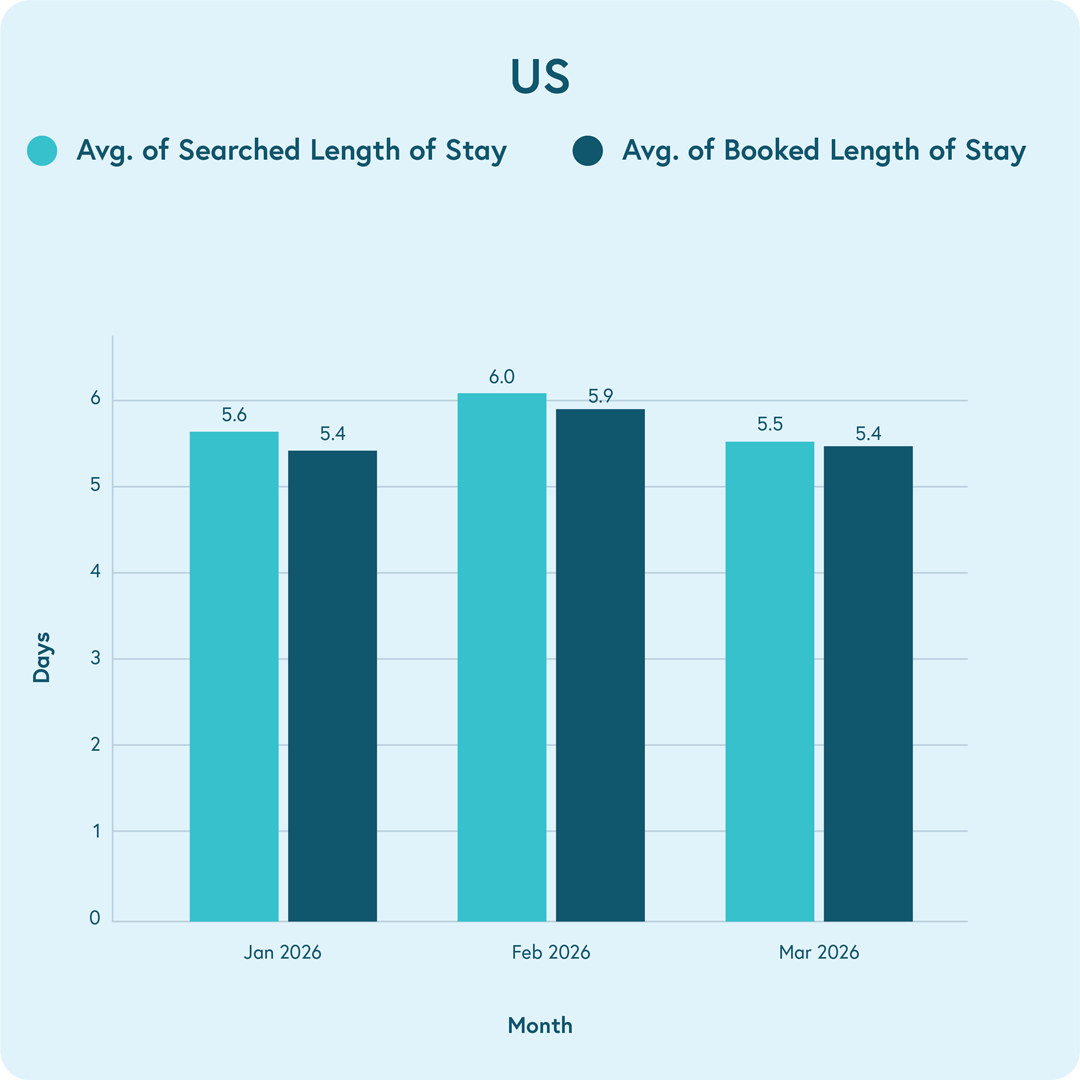
Traveler intent doesn’t always translate directly into bookings, and understanding that gap is key to planning for 2026. By comparing searched versus booked length of stay across markets, we can see how traveler curiosity differs from actual commitment. This data reveals how guests are thinking about their trips, whether they’re dreaming of week-long escapes but settling for weekends, or increasingly seeking extended stays. For hosts and property managers, these patterns highlight where to adjust pricing, minimum-stay rules, and marketing strategies to better capture emerging demand and convert intent into revenue.The data shows the average searched length of stay vs. the actual booked stay for the first quarter of next year (January-March).

United States

In the U.S., searched and booked lengths of stay are closely aligned, with only slight variances month to month. This suggests traveler intent is translating directly into bookings, a sign of market stability and strong pricing alignment. Guests appear confident in their plans, booking stays nearly as long as they initially search for, which bodes well for consistent occupancy early in 2026.

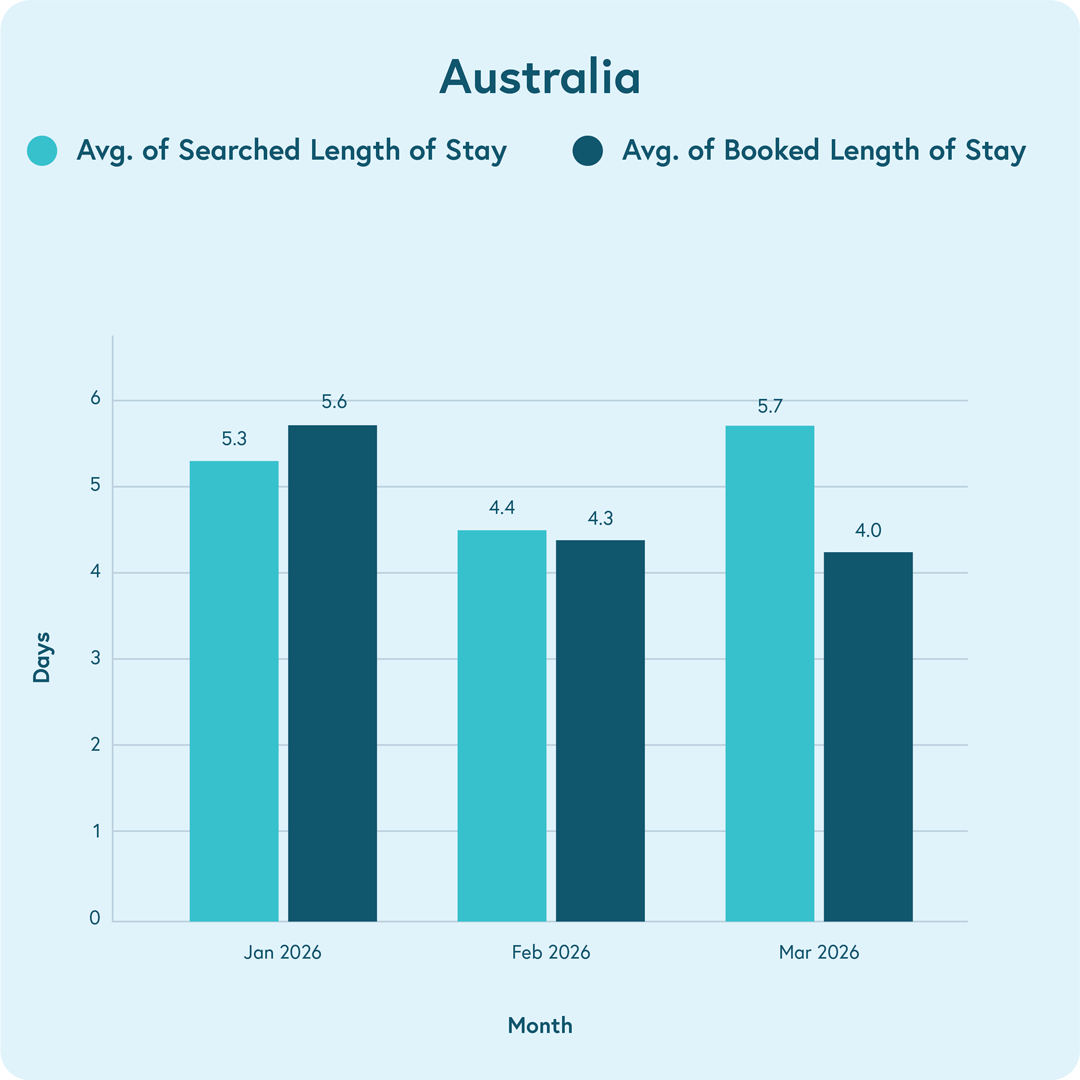
Australia

Australia shows a more noticeable gap between searched and booked stays, particularly in March, where guests are searching for longer trips but booking shorter ones. This could point to price sensitivity or limited availability during peak travel months. Hosts may benefit from testing long-stay discounts or loosening minimum-stay rules to better convert intent into bookings as travelers plan their early 2026 holidays.

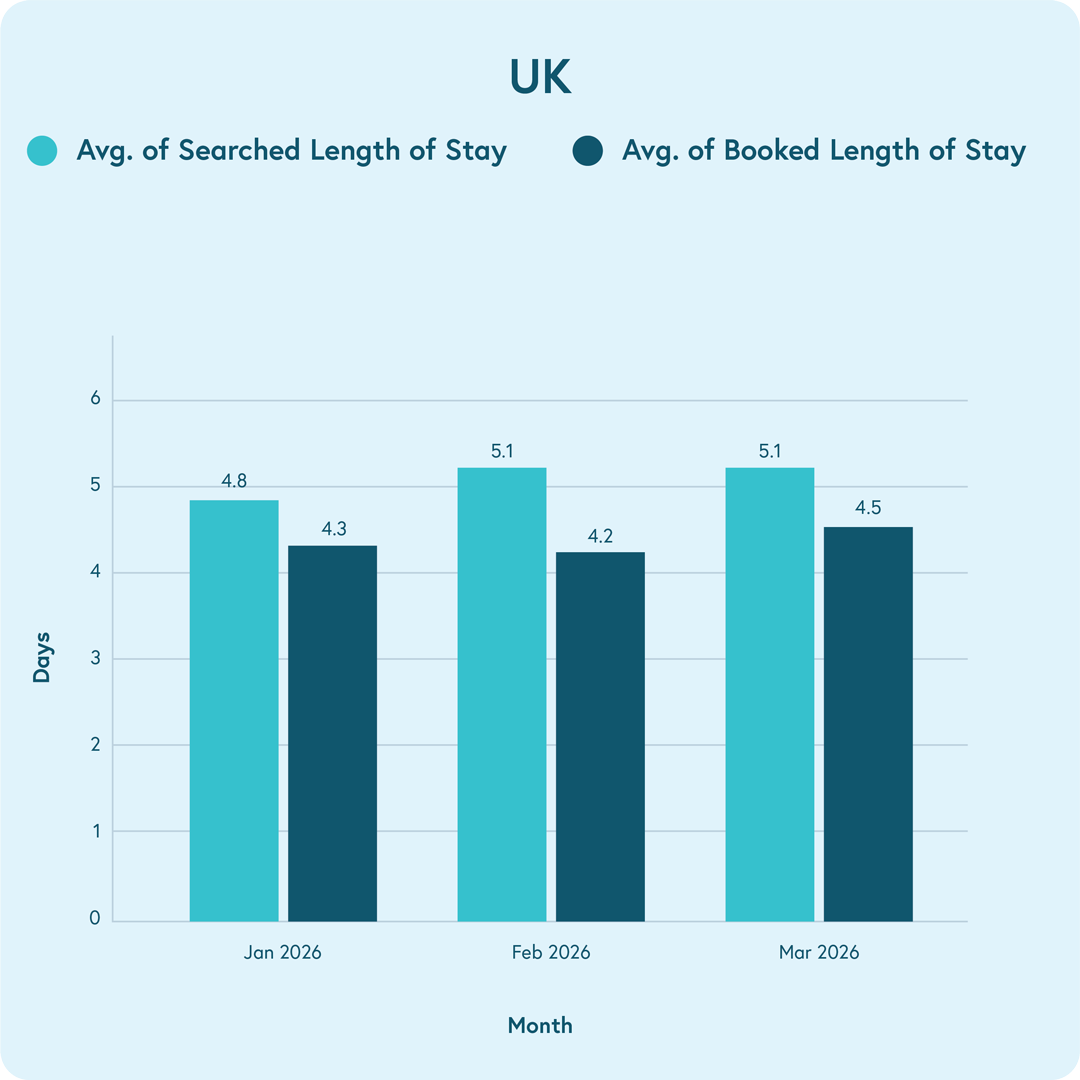
UK

In the UK, guests are consistently searching for longer stays than they ultimately book, with a noticeable gap throughout Q1. This trend suggests that while travelers are interested in extended getaways, factors like pricing or travel flexibility may shorten actual bookings. Hosts could experiment with midweek pricing or added-value offers to encourage guests to extend their stays and close the gap between intent and conversion.

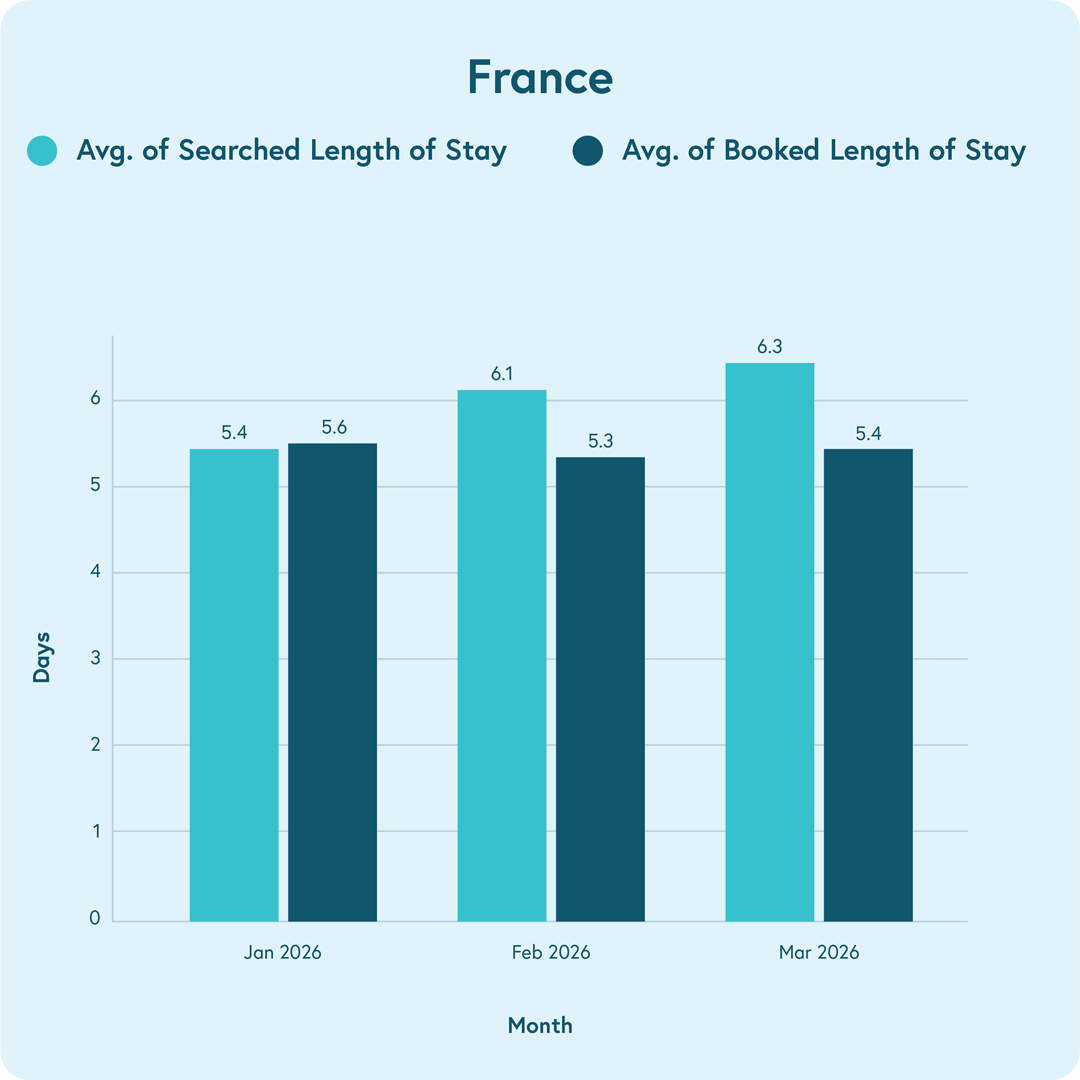
France

France shows a good alignment between searched and booked lengths of stay, with booked stays even exceeding searches slightly in January. This balance indicates that travelers are following through on their initial trip plans or even opting to extend once they commit. For property managers, this points to a healthy market with steady confidence and room to optimize around longer-stay demand heading into early 2026.

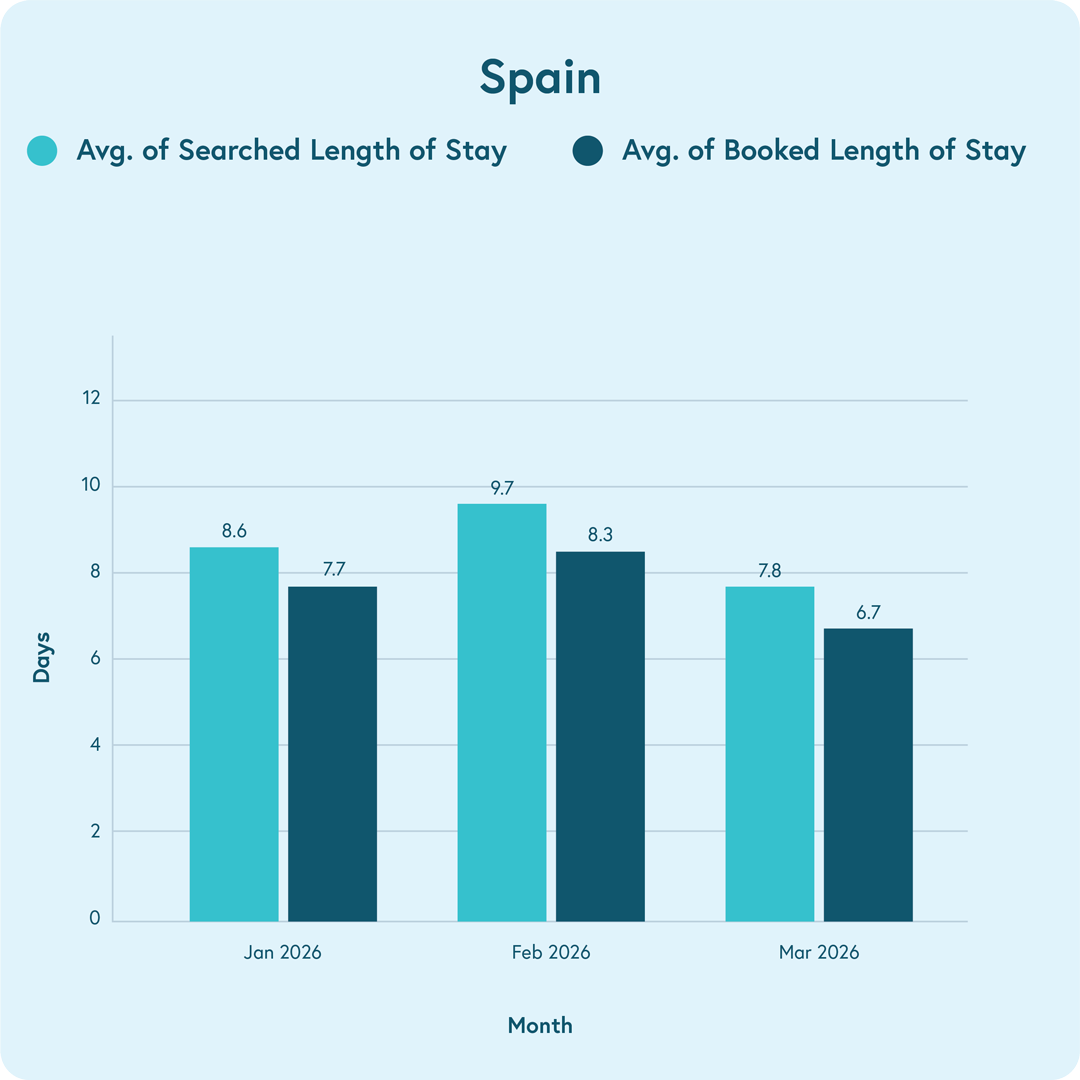
Spain

Spain shows a consistent gap between searched and booked stays, with travelers initially exploring week-long or longer vacations but ultimately booking shorter visits. This suggests travelers are aspirational in their early searches but constrained by budget or time when finalizing trips. Hosts could test promotional pricing for stays of seven nights or more to better align with that initial intent and capture extended-stay demand.

Italy

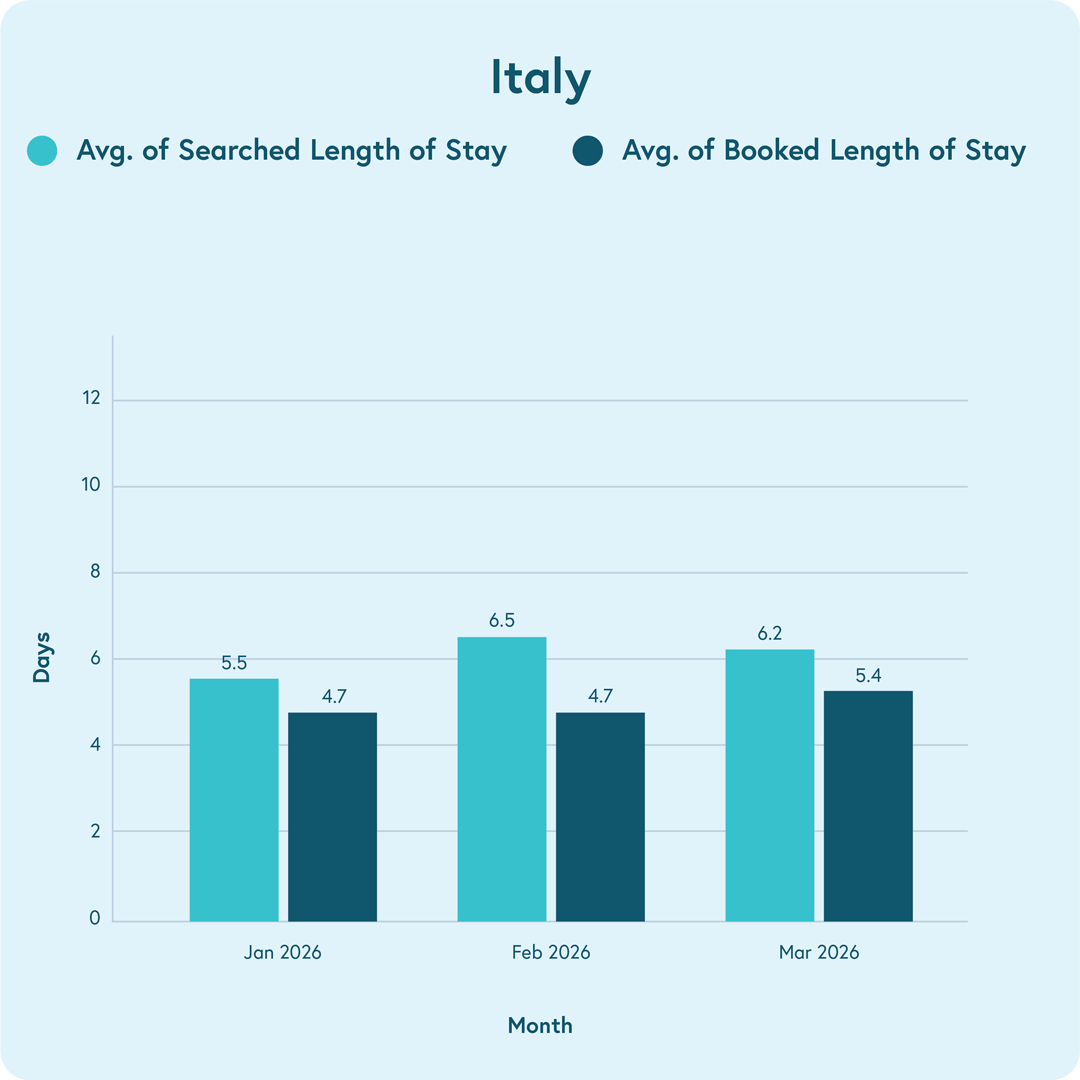
In Italy, searched lengths of stay consistently exceed booked stays across Q1, highlighting high interest in longer trips, especially from international travelers, that may not yet be converting. This gap signals an opportunity for hosts to refine long-stay pricing, emphasize flexibility, and market extended experiences to appeal to guests considering multi-city European itineraries in early 2026.

Portugal

In Portugal, guests are searching for stays longer than the ones they’re actually booking. It’s a signal that travelers are exploring extended trips but haven’t fully committed yet. For hosts, that means an opportunity to adjust long-stay pricing, showcase flexibility, and attract those planning multi-stop European journeys in early 2026.

Dubai

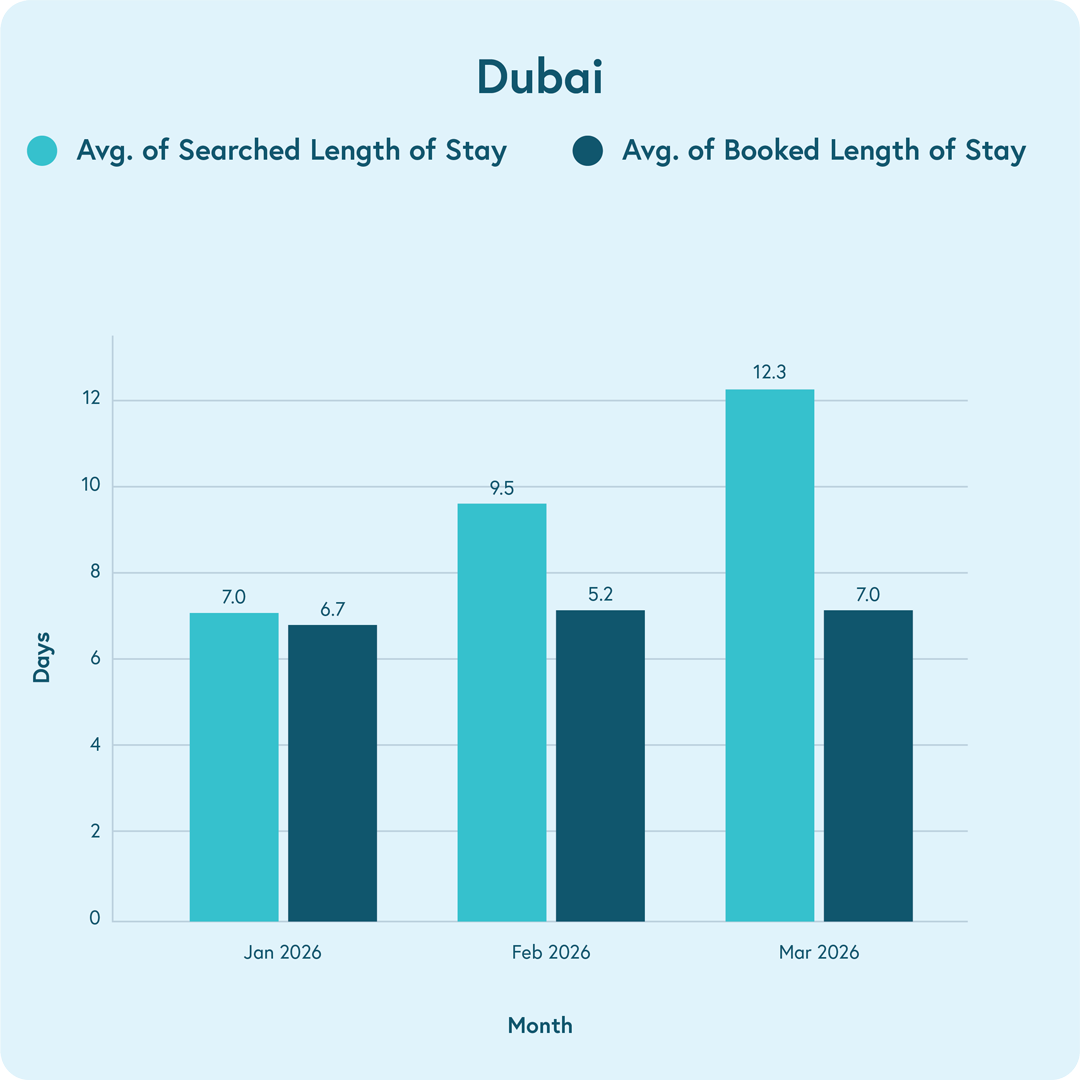
In Dubai, data reveals a clear 4-day gap between searched and booked lengths of stay in February and March, the peak of the city’s high season. Travelers are exploring longer trips, but bookings remain shorter, suggesting that interest in extended stays isn’t yet converting. This insight points to an opportunity for property managers to optimize long-stay pricing and position Dubai as an ideal destination for longer leisure or workation stays, especially as international demand continues to grow in early 2026.

Mexico

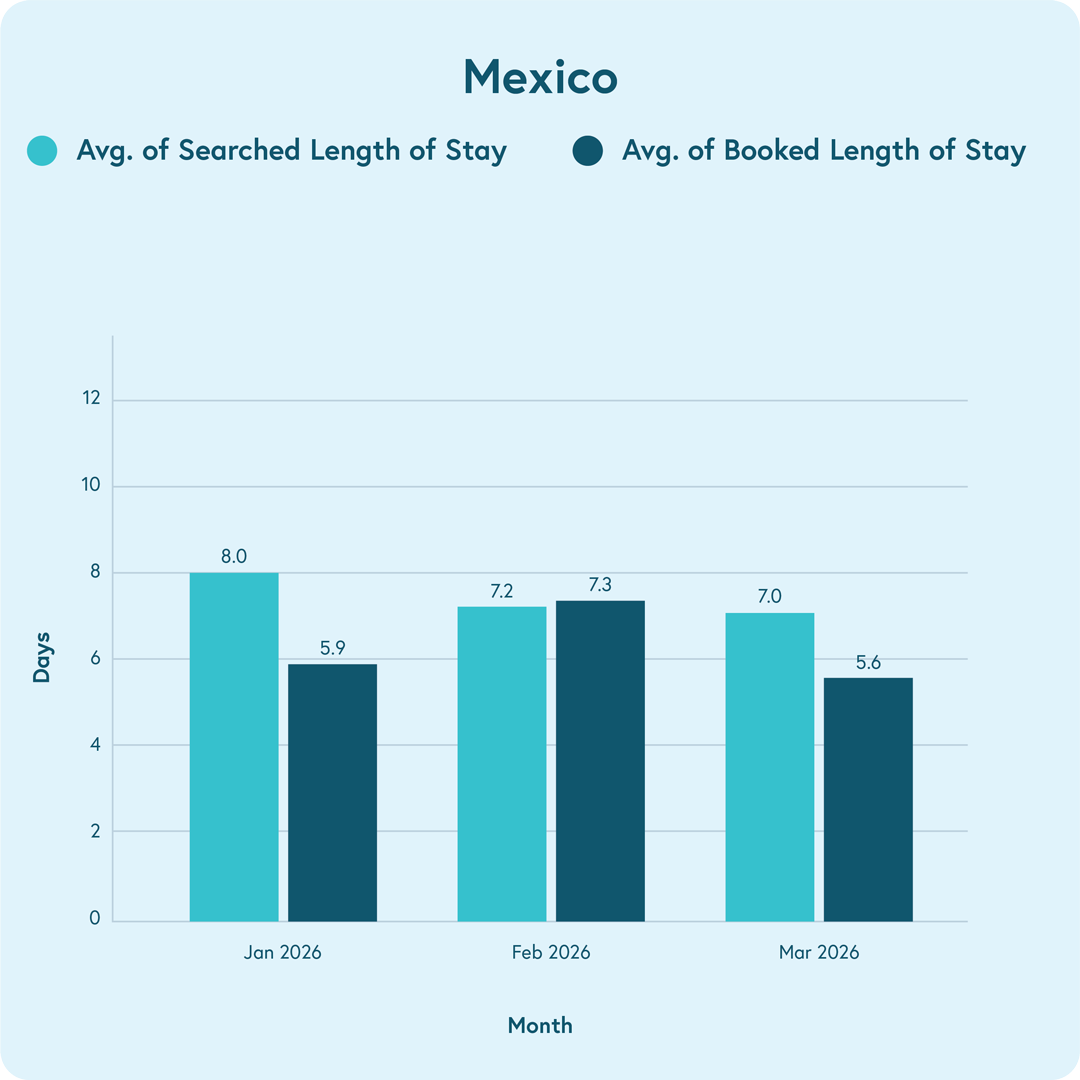
Mexico’s data reveals one of the wider gaps between searched and booked stays, with travelers dreaming of week-long getaways but often booking just 5-6 nights. This indicates strong aspirational travel intent but potential barriers like pricing or flight timing. Property managers could benefit from long-stay incentives or highlighting value-added amenities (like weekly cleaning or workspace setups) to turn extended-stay interest into confirmed bookings.

Brazil

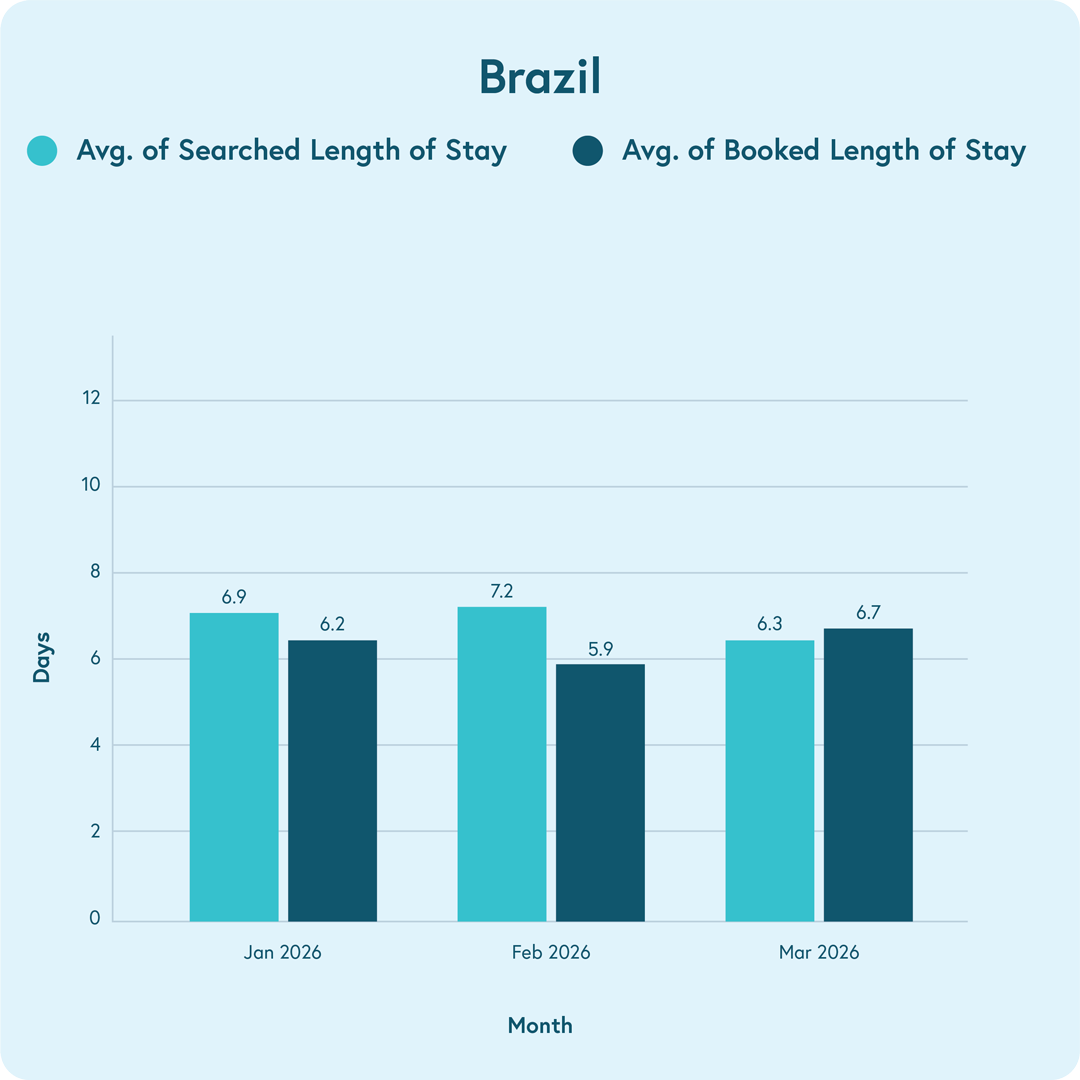
In Brazil, data reveals a significant gap in February – traditionally one of the country’s most attractive months for travelers, thanks to Carnival. While search behavior shows strong interest in longer stays, actual bookings tend to be shorter, suggesting that travelers are exploring extended trips but not yet converting them into reservations. This disconnect highlights an opportunity for property managers to optimize long-stay pricing, introduce flexible minimum-night policies, and promote experiences tailored to extended vacations during the peak periods, when both domestic and international demand surges.

Across every market, one thing is clear: 2026 guests are already shaping their own version of travel recovery, one defined by confidence, flexibility, and data-backed decision-making. Whether it’s local guests booking closer to home or international travelers dreaming of longer stays, the operators who succeed next year will be those who listen to these early signals and act on them.

But to understand where we’re headed, it’s worth looking at how we got here. The lessons of 2025 shaped the foundation for what’s next, revealing exactly which strategies separated the strongest operators from the rest.

2025 in Review

Revenue Management's Biggest Learnings

2025 tested the short-term rental industry and redefined what success means.

Across global markets, operators faced rapid change: tighter regulations, sharper competition, and shifting traveler behavior. The challenges weren’t new, but their speed was. And in that acceleration, one truth emerged: success depended on agility, precision, and smarter use of data.

The Volatility Paradox

Demand in 2025 became both more predictable and more volatile, a paradox that confused many operators but empowered the prepared few.

Guests were booking later, deciding faster, and expecting availability in real time. Traditional forecasting, built on historical booking curves and annual patterns, couldn't keep pace. The booking window was no longer a steady calendar; it was a moving target that rewarded speed over stability.

The takeaway: Operators needed systems that could sense and respond to demand shifts within days, not weeks. Systems that treated volatility as opportunity, not chaos.

Tight Rules, Tighter Margins

Regulation continued to tighten its grip on the short-term rental industry in 2025, especially across Europe, where stricter rules slowed new supply and drove up operational costs. Cities introduced tougher licensing, occupancy limits, and compliance checks, forcing operators to rethink how they run their businesses.

Meanwhile, in the U.S., the first quarter of 2025 brought its own kind of disruption. Tariffs and a flurry of political headwinds created ripple effects that reshaped travel patterns. Searches from Canadian travelers for U.S. short-term stays dropped 50% in March and April compared to 2024, according to Beyond, highlighting how uncertainty and shifting economic sentiment were already influencing cross-border travel behavior.

For some, these changes became roadblocks. For others, they were a catalyst. The operators who thrived weren’t the biggest; they were the most efficient. Instead of chasing rapid expansion, they refined their operations, leaned into automation, and focused on profitability over portfolio size.

The takeaway: In regulated or unpredictable markets alike, revenue efficiency mattered more than revenue growth. Success came from precision, not scale, and getting the most out of every booking, every night, and every property.The takeaway: In regulated or unpredictable markets, revenue efficiency mattered more than revenue growth. Success came from precision, not scale, and getting the most out of every booking, every night, and every property.

The Technology Lag

One of the most defining challenges of 2025 wasn’t market-driven, it was technological. Many operators relied on tools that were functional but not forward-thinking: simple pricing systems, manual pacing checks, and fixed comp sets based on historical data that were built for a slower era. These tools checked the box but missed the opportunity. They managed revenue after the fact rather than anticipating it.

The most successful operators took a different path. They used advanced data sources like search trends and real-time market signals to predict demand before it hit. They automated, connected, and optimized, turning technology from a task manager into a decision-maker.

The result? While some were still updating prices once a week, others were running businesses that adjusted, benchmarked, and strategized in real time.

The takeaway: Technology alone wasn’t the answer. The edge came from automation powered by high-quality, predictive data and systems that didn’t just react to demand, but anticipated it.

The Operationalization Gap

Even for operators who understood what needed to change, the challenge was how to change it. Advanced revenue management strategies—dynamic pricing, intent-based forecasting, real-time benchmarking—weren't hard to conceptualize. They were hard to operationalize.

Teams were stretched thin. Data sources were fragmented. Decision cycles were slow. And even when operators had the right tools, they often lacked the rhythm, process, and culture to turn insights into action at the speed the market demanded.

The takeaway: The next evolution of revenue management wasn't just technical—it was organizational. Success required systems that reduced complexity, accelerated decisions, and freed teams to focus on strategy rather than customizing endless settings or sorting through multiple tabs of data. Operators who ensured that revenue management is a core skill set within their team, rather than a side-job for someone to tackle at the end of their day-to-day, are those that are strategically growing their business no matter the market conditions.

The Turning Point

All of these shifts became the story of 2025, one told through data, performance, and the operators who adapted fastest. This was the year the industry learned that success isn’t about more tools or bigger portfolios. Instead, it’s about using automation and high-quality data to make faster, smarter decisions.

Market and Search Data Trends

Across the globe, short-term rental signals were clear: occupancy became the engine of growth. The best operators didn’t chase higher prices right away. They captured more nights and occupancy first, converting missed demand into measurable growth, followed by price increases as needed

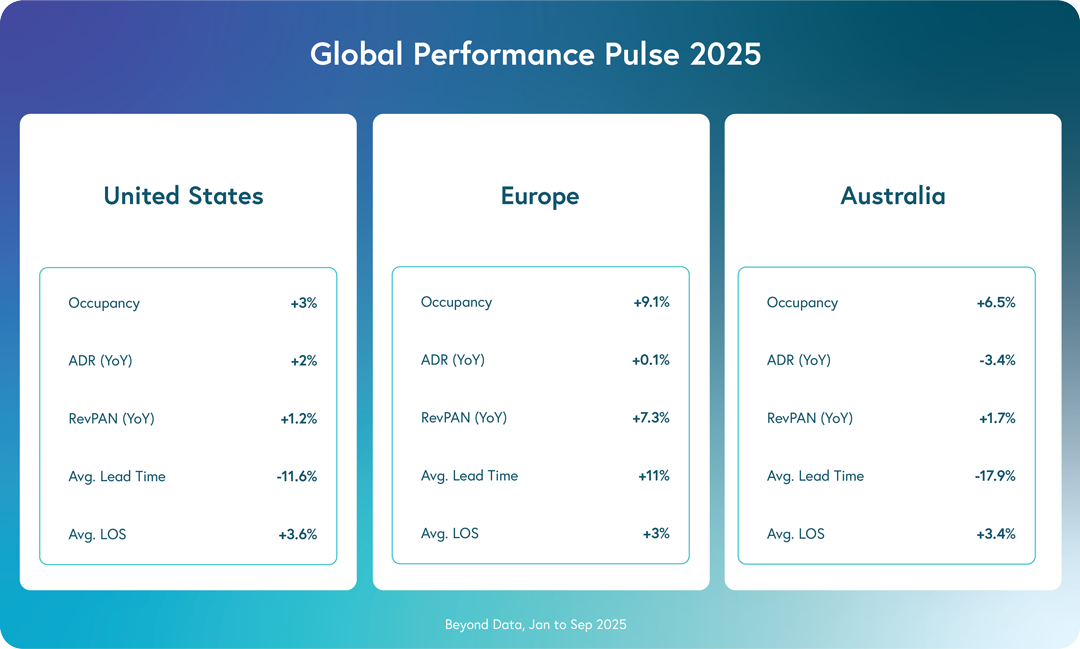
  • The U.S. finished at 53.1% occupancy with a 3% lift year over year and ADR up 2% to $248.71, which produced a modest revenue per available night (RevPAN) gain of 1.2%.
  • Australia’s story was clearer: occupancy rose 6.5% to 52.3% while ADR slipped 3.4% to $187.74, yet RevPAN still improved 1.7%, signaling demand capture outweighed pricing softness.
  • Europe posted the strongest occupancy momentum at +9.1% to reach 50%. ADR was essentially flat at +0.1%, but RevPAN climbed 7.3% on the back of fuller calendars.

Guest behavior reinforced this pattern. Length of stay edged higher across the board, reaching 5.7 nights in the U.S., 6.0 in Australia, and 6.6 in Europe. Lead times shortened in the U.S. to 26.8 days and in Australia to 22 days, while Europe moved the other way to 35.1 days.

The Guest Behavior Shift

If 2025’s market data showed how the industry performed, guest behavior revealed why. Three shifts stood out across global markets:

  1. Later bookings, same stays.
    Guests booked closer to check-in than they did two years ago, particularly in the U.S. and Australia. Booking windows tightened, yet average stay lengths held steady or even increased. Travelers waited longer to commit but didn’t shorten their trips, signaling confidence in last-minute planning and trust in available inventory.
  2. From static pricing to real-time agility.
    Operators who matched this faster pace with flexible, data-driven pricing captured the most revenue. Static, weekly adjustments couldn’t keep up with shifting intent, especially during compressed booking windows.
  3. Visibility became the advantage.
    Those using advanced data, from search signals to demand surges, could see intent before it converted. These operators repositioned inventory and adjusted pricing early, turning volatility into an opportunity rather than a risk.

Regional Callouts

Outperforming the Market

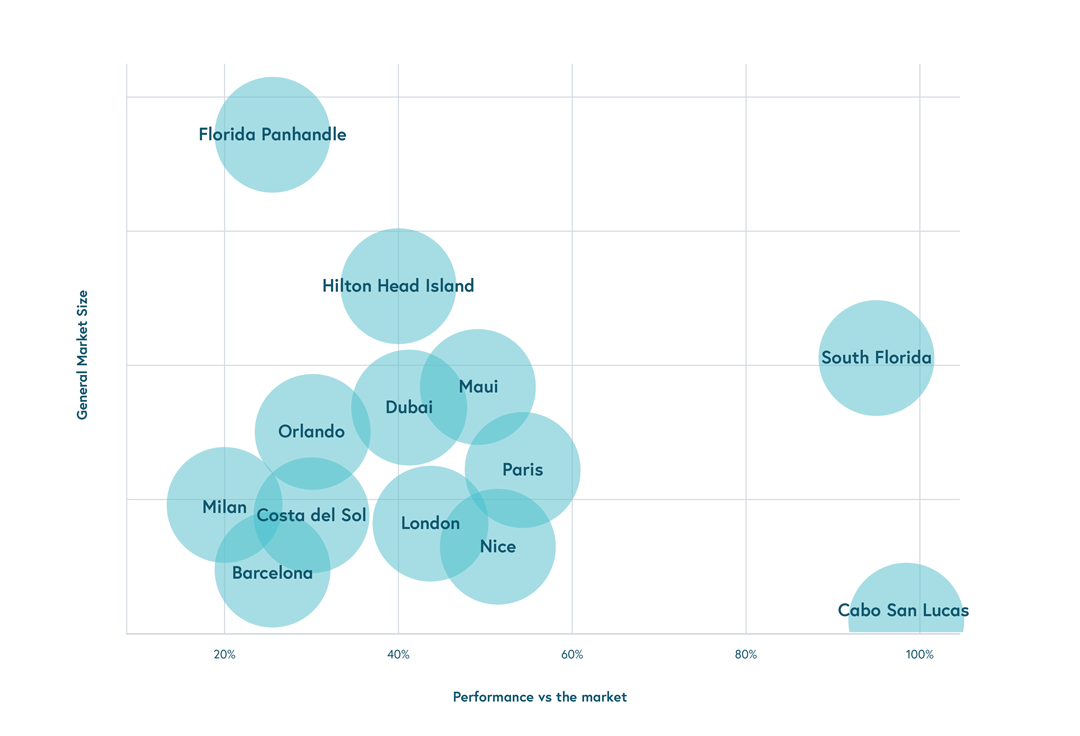
While many in the industry were still reacting to volatility, Beyond customers were anticipating it; leveraging search data, pacing insights, and automated pricing adjustments to act on demand before it fully materialized.The chart highlights a sample of destinations where Beyond customers outperformed their local markets in 2025. Each bubble represents market size and relative performance, showing how operators using Beyond’s revenue management system consistently captured more value than their peers.

United States | From Volatility to Velocity

2025 began unevenly, but the fastest responders won. Domestic demand stayed strong, and the gap between available and booked nights narrowed sharply.

High-performing regions like Florida (+25%), Hilton Head (+41%), and Maui (+49%) showcased how intent-led revenue management and automated rate adjustments aligned with real-time search trends to deliver outsized results.

Brian Olson | Owner of Beachcomber Vacation Rentals

Many of our properties are in drive-to markets, which makes it easier for guests to book with short notice. This year, after major corporate layoffs and economic uncertainty, we noticed that guests searched in advance but held off booking until the last minute to make sure they had the funds available. With Beyond’s search data, I could see the demand and knew that bookings would materialize, which helped me hold firm on price without offering discounts.

Europe | Maturity Over Momentum

Europe faced regulatory friction and slower supply growth yet saw +9% occupancy gains with stable ADR. This was the hallmark of professionalisation: operators focusing on systems, not spreadsheets. Cities like Paris (+55%), London (+45%), and Nice (+51%) demonstrated how refining stay rules, content, and restrictions, not just rates, translated into stronger RevPAN.

William Asbury | Founder Director at Guesthoo

We’re seeing AI becoming an integral part of the short-term rental industry, helping with menial tasks and basic guest communication. Rather than replacing staff, it's allowing them to spend more time on the things that matter. Overall, enhancing guest experience and providing a better service. At the same time, Booking.com continues to gain ground in the self-catering holiday home market — trends that will reshape how property managers compete globally.

Australia | Agillity at Scale

Australia maintained steady domestic demand, delivering +6% RevPAN growth despite economic headwinds. Shorter lead times reflected travelers growing confidence to book last-minute, and operators’ readiness to flex. Dynamic pricing and flexible stay rules drove gains, particularly in coastal regions where weekend travel surged. Beyond data shows that listings managed with live market visibility saw occupancy improvements of up to 4 points over static peers.

Hamish Smith, Director at Experience Jervis Bay

AI will continue to complement our industry by making the cornerstones of short-term rentals — guest communication, customer service, rate management, property management, and after-hours assistance — more efficient.While we’re not early adopters, we take a measured approach, choosing proven tools that integrate seamlessly into our tech stack. In 2026, we plan to implement several AI solutions to enhance our operations, dedicating time to training, prompts, and tone of voice. We’ll use AI to drive efficiency, while ensuring our local, personal touch remains ever present.

The Takeaway: 2025 confirmed what many had suspected: traditional metrics are lagging indicators. Occupancy and ADR still matter, but how and when you achieve them matters more. Operators who combined real-time demand data with dynamic response outperformed their peers in their markets. That advantage, born from intent visibility and execution speed, sets the stage for the next evolution of revenue management.

Sommario

27%

2026 Macro Themes
Guest Demand Insights
Length of Stay Patterns
2025 Highlights
Market & Search Trends

The next step is turning those lessons into action. Here’s how operators can build on what worked and use new tools and strategies to stay ahead in 2026.

How to Get Ahead in 2026